
France
Small Boat by Vincent Delecroix (2023)

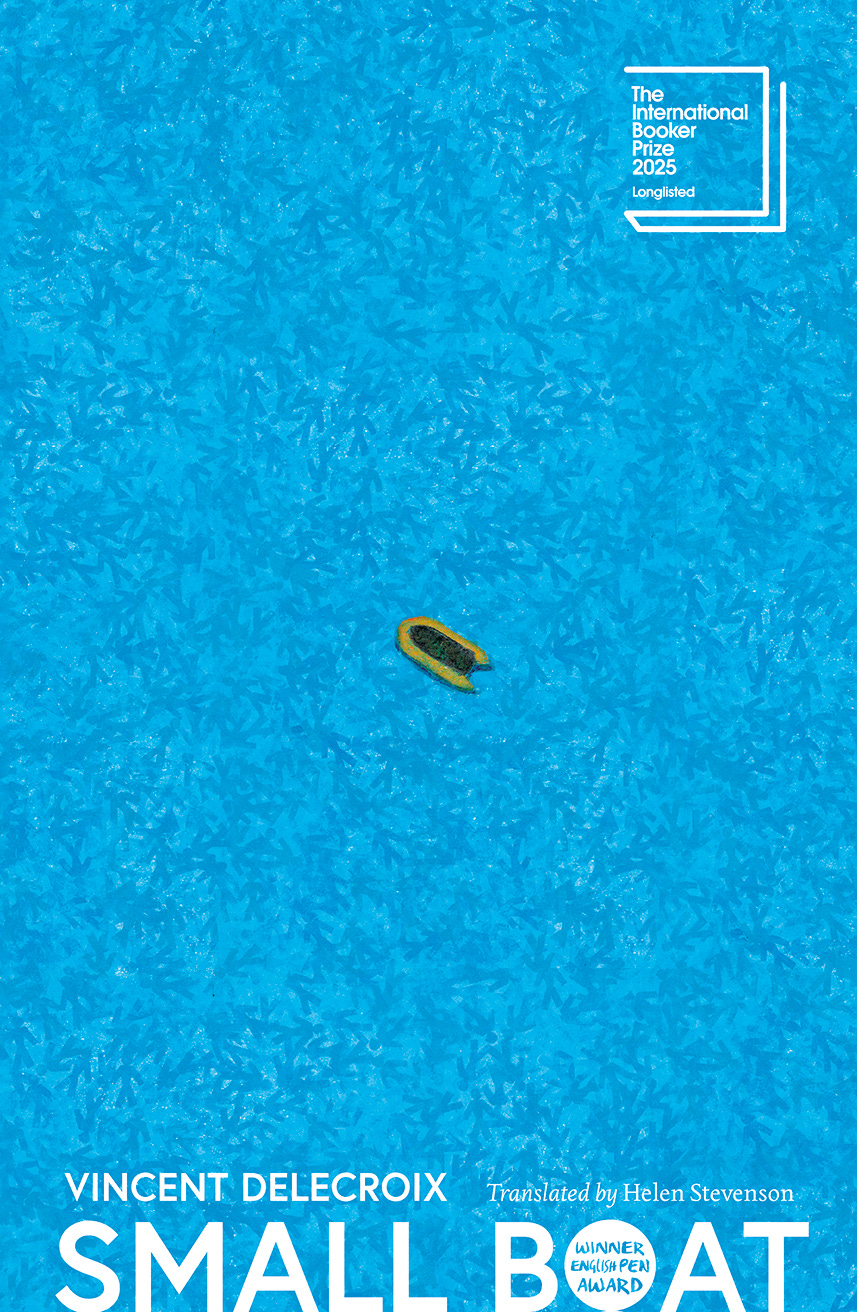
I took a long break from reading around the world1, because I found that, in an effort to learn the most about each country, I was consistently picking pretty heavy books that would sometimes bring my mood down. So, I’ve resolved to just read internationally written books and maybe revisit countries if I find other books I think are interesting from there.
In that spirit, I picked up Small Boat by Vincent Delecroix, which is a short book that invites lengthy thought. It’s not old enough to be an unequivocally iconic piece of French literature, but it caught my eye when it was shortlisted for the 2025 International Booker Prize. The book centers on the real incident back in 2021 where 27 migrants traveling on an inflatable raft from France to the UK died. These people called the French authorities for help more than a dozen times over the course of several hours. The French and British authorities passed the responsibility back and forth — at one point, a third party even saw the migrants and phoned in to ask if they should conduct a rescue, but they were told to stand down. The book starts from this true event and weaves a fictitious story around it.
The central focus of the book is on the French coastguard operator who received these distress calls. She had (in real life and in the book) replied callously to one of the desperate calls for help, saying “Don’t you get it? You won’t be saved. ‘I’m up to my feet in water'? It wasn’t me who told you to leave.” The opening scene, which stretches into the first half of the book, is her intense interrogation by a police inspector to identify what blame can be assigned to her in this tragedy. The inspector presses her, in an alternating cadence, on her failure to do her literal job as well as the moral implications of her statements. The operator insists that the only moral transgression she committed — if it can even be called as such — was to be honest at a time when others believe she should have been compassionate and reassuring. She insists that her training was intended to make her indifferent to what sorts of people are in distress, and her lack of compassion does not make her responsible for what happened to them.
It’s incredible how much this book makes the reader vacillate between empathy and disgust toward the operator. Through the operator’s Mersault-esque ramblings, we gain insight into how difficult it is to repeatedly bear witness to such tragedies while trying to coordinate scarce resources from a distant glass tower. The operator adopts the mentality of a true detective and traces the causal chain of events: “Their sinking didn’t start in the Channel; it started the moment they left their homes. Maybe they even started to sink the day they got the idea in their heads that everything would be better elsewhere.” As she pushes even further, she discovers her position as the scapegoat, though it’s unclear who set her up exactly. Her profession demands this emotional detachment and imposes a bureaucratic inertia so massive that we find it hard to blame her as an individual. At the same time, the dehumanization of such a widespread crisis is a shock to the system every time it resurfaces in her internal monologue.
Delecroix is a Kierkegaardian philosopher as well as a novelist, and it is incredible to see these two skillsets at play here. The arguments are made precisely but unraveled chaotically, mirroring the frantic thoughts of a person under duress. The final section of this book makes us question if the interrogation was even real or simply a conversation that took place in her head. Altogether, I really enjoyed this beautiful and deep meditation on guilt and conscience in a world that increasingly loves to point fingers and assign blame. Small Boat did not win the International Booker Prize. I haven’t read the other candidates, but I am certain that this book will stay with me for a long time. Here are some quotes I really loved:
“It might have been an idea to ask this question, in seeking to shed light on the matter, and it might then have become clear that what happened to them was simply, in the end, the outcome of a long process or a long story that had nothing to do with me. I was just the last link in the chain, when it was almost too late.”
“Empathy, I said to the police inspector, is an idiotic luxury indulged in by people who do nothing, and who are moved by the spectacle of suffering.”
I did not stop reading though! I spent quite some time working through The Licanius Trilogy, among other fantasy / science-fiction books.
I also think the interrogation was in her imagination. I think she lost her nerve and didn't go in. I've never found anyone else who thought this was a possibility, until now! I loved this book too and wish it had won the IBP.